 |
| "New Blood" "Shock Top" Of Sand Wash Basin Dam: Demi the Domestic Horse Sire: Haze Mustang Wild Horse of Sand Wash Basin 8 by 10 Inches Watercolor by Linda L Martin $400.00 Prints Available on Fine Art America Click Here: NEW BLOOD Photo references by John W. Wagner |
Showing posts with label MustangADayChallenge. Show all posts
Showing posts with label MustangADayChallenge. Show all posts
Saturday, June 6, 2015
"New Blood" 2014 Colt "Shock Top" - Mustang A Day Challenge Painting #454

Friday, April 26, 2013
Kissy, Orphan Foal of Sand Wash Basin Challenge Painting #405
Kissy the Orphan Foal and her Oldest Brother Stomper
 |
| "Stomper and Kissy" 5 by 7 Graphite on Paper by Linda L. Martin Artist Original $75.00 11 by 8.5 inch in house signed prints available for $35.00 each contact me via Info@llmartin.com |
Reference photography thanks to John Wagner and Patrick Brennan
Wednesday, October 17, 2012
Image #356 Reflections (Finished) Corolla Herd from The Outer Banks of North Carolina
 |
| "Reflections" Corolla Wild Horse 8 by 10 inches Original Watercolor by Linda L Martin Artist $350.00 |
These small horses are sometimes called Banker Horses or Banker Ponies because of their size. Usually they are about the size of a mid-sized pony when running in the wild. The reason they are so small is because of their diet of marsh grasses.Their thin bloated belly appearance is caused by drinking brackish water. In-fact in the whole of the Outer Banks island system there is no fresh water for wild things, except when the occasional rain storm fills in the gathering pools. At one time, before development encroached in to the range of the horses, they also would dig through the sand to find fresh water according to one account of their history.
 |
| A wild Banker Horse grazes next to a housing development. These horses desperately need the protection of an uninhibited range. Since the development of residential areas along the islands of the Outer Banks of North Caroline, the horses not only have to compete with thousands of tourists, but also huge numbers of houses cluttering their habitat. Photography by Kim Galluzzo. Used by Permission |
Unlike the Chincoteague and Assateague ponies in Virginia, Banker Horses are found in solid colors of bay, chestnut, Chestnut with Flaxen Manes and Tails, black, brown, and buckskin. They do, on occasion, have some white markings, sometimes on their faces and/or their legs below the knee. The horses are currently managed by the Corolla Wild Horse Fund.
Like all the wild horses on the Eastern barrier Islands of the United States, the Corolla herd is not protected under the Wild Horse And Burro Act. To read more about the Corolla herd and what they are doing to have the herd legally protected, you can read about the history and goals here: http://www.corollawildhorses.com/facts-and-history/
Reference photography for tonight's painting provided by Kim Galluzzo.
Thursday, September 13, 2012
Happy Adoption:Mustang Sally, Twin Peaks HMA, Painting # 338
 |
| "Mustang Sally" 4 by 6 Inches Watercolor by LndaLMartinArtist $35.00 |
Here is the story of Mustang Sally in the words of her owner Cherlynn Raffone:
"I have an 2005 bay mustang mare, gathered from Twin Peaks HMA(California) as a yearling. She competed in the '08 Midwest Mustang Challenge and came in 5th out of 50.
From their she was adopted out to a man in NY on Long Island, where I currently reside. He had her for only a few months and sold her. She then went through 7 different owners all saying she was crazy and too much to handle. Well here we are a 1yr 1/2 later.
We have had our ups and downs, but now its just up up up. I love this horse so much! She gives me strength and faith. She is an amazing trail horse, rides english/western, works cows, does barrels and poles like its her job. She loves to jump. She is that great all around horse that everyone wants. I'm proud of her and what she stands for. I'm honored to say I own an American Mustang."
Blogger's Note:
Mustangs are easy to adopt, simply by meeting the requirements set down by the BLM. The most successful adoptions are the ones where the person adopting the horse asks questions and even takes instruction or advice from others who have successfully adopted and built relationships with their horses.
Give yourself a head start in learning how to work with wild horses using natural horsemanship methods and networking with as many mustang owners as you can. This way you can share you successes and learn from each other's mistakes. Don't expect that one class or session will get you there, because each wild horse is different, with different experiences in the wild, during and after capture. Your job is to learn your horse, while he learns you and to build trust and understanding while you do it. It wont always be easy but the rewards are amazing especially the first time that wild horse comes to you to let you touch him because its his idea.
Every day I hear testimony after testimony of how fun wild horses can be. They not only have skills of independent thinking and living in social units but they translate that fun into games with you that develops a bond like no other.
Adopting a mustang also helps with the growing problem of too many wild horses that are no longer on the range. Once a horse has three strikes, meaning they have been offered for adoption 3 times they are then designated as a three strike horse and shipped to a Long Term Holding Facility(LTH) These facilities are also known as sanctuaries. In these sanctuaries as many as 5,000 wild horses run in freedom, with in the confines of a ranch.However, all the stallions are gelded and the herds are kept as same sex groups that do not reproduce.
The horses can be purchased in groups by approved individuals. Sometimes a trainer will offer to purchase a trailer load of these horses directly from the facility or simply buy one or two Sale Authority horses to bring home and invest time in. However, most are never seen by the public again because they are warehoused on private property. Once a horse enters LTH they become invisible, unless you know their registration number or their brand. They can be found via their brands.
Please considerer adopting a wild horse and take the time to learn how to handle it, building a relationship with them. In this way, one by one, we help protect the wild mustang horses that are in captivity, while we are also protecting wild horses in the wild..
If you would like more information on Adopting a wild horse please go to the BLM adoption page: http://www.blm.gov/wo/st/en/prog/whbprogram/adoption_program.html
If you live in the Mid-Atlantic States on the East coast of the US and are already a successful adopter or would like to network with other successful wild horse or burro adopters feel free to message me here or join us on the facebook page https://www.facebook.com/MidAtlanticWildHorseProject
To have your horse painted for the Mustang A Day Challenge contact the artist at: llmartisticservices@yahoo.com
Tuesday, September 11, 2012
Happy Adoption: Rhett Adopted through the TIP Program Painting # 336
 |
| "Rhett" 4 by 6 inches Watercolor by LindaLMartinArtist $35.00 |
Nicole Stuart McAleer's story on how Rhett came be hers:
"Last fall (2011) I was helping a trainer with her mustang for the Extreme Mustang Makeover. After that mustang she loved it so much that she brought in 4 TIP horses. At the time I couldn't have one because I already had 2 horses. About 40 days after the TIP horses came in my 5 year old gelding passed away of unknown causes. I was devastated and so was my mare. The TIP trainer informed me that "Brownie" as he was called, was still available and asked if I was interested. I couldn't resist the idea of a mustang, as I have always wanted one. So in January of 2012, I brought him home.
My favorite book is Gone With The Wind.My mare came with the name Scarlett, so that is where the name came from. We thought BLM's Gone With The Wind was a good name and call him Rhett around the house. He spent 30 days with a trainer and withing 6 months we allowed beginners to ride him. He has a wonderful temperament and is a pleasure to own. Other than my mare I don't think I will ever own another breed!!"
The Tip program ( Trainer Incentive Program) is a good way for a new adopter to adopt their first mustang. The trainer must be approved by the Mustang Heritage Foundation then they have a period of time to handle the mustang that is fresh off the range. The horse is gentled, feet handled and most of the ground work is done to make sure the horse can be handled safely for grooming, vetting, hoof care, haltering and leading and loading safely into and out of a trailer.. Tip trainers can also help with additional training for the first time owner. To find out all the requirements to adopt a mustang through the TIP progam please go to http://www.mustangheritagefoundation.org/trainers.php
Just click on the map for trainers near you.
Tuesday, April 10, 2012
Mustang A Day Challenge Painting # 298 Megan Jones' Nevada
 |
| "Nevada" 4 by 6 inches Watercolor by Linda L Martin Artist $35.00 |
Megan sent me some amazing photos documenting the training of her Mustang Nevada. I suppose I could have done a traditional head portrait of him. But I was thinking back to my younger years with my own black horse and sitting in the pasture while he grazed just being together.
Its more amazing when you think that this beauty of a black horse with his white blaze was wild and has had less than 18 months of training when he arrived at Megan's home.
Megan adopted Nevada at the CSU Mustang makeover in 2010. He had been aged at 4 years by the BLM but seemed younger to her. From Megan's Facebook Page: " I can't say enough Good things about Steve, the trainer that took him on for the EMM(Extreme Mustang Makeover). He is like no other horse I've ever worked with . He (Nevada) stepped up on this obstacle the very first time I asked him to . He's just incredible ."
When I was a child they were still force breaking wild horses. Gosh, they were force breaking almost every horse. And some of them were so scared that they were never safe to ride. Others were so severely injured that there was nothing left for them but to be put down. Some grew to hate people and would literally fight to the death rather than submit. It was a rough time for horses and for the people that tried to "break" them. Breaking is pretty much what they did, too. Bones and spirit of both the men and the horses is some sort of conquering war that enslaved the animals until they were useless, in some cases, and the men so crippled they were useless too.
Its more amazing when you think that this beauty of a black horse with his white blaze was wild and has had less than 18 months of training when he arrived at Megan's home.
Megan adopted Nevada at the CSU Mustang makeover in 2010. He had been aged at 4 years by the BLM but seemed younger to her. From Megan's Facebook Page: " I can't say enough Good things about Steve, the trainer that took him on for the EMM(Extreme Mustang Makeover). He is like no other horse I've ever worked with . He (Nevada) stepped up on this obstacle the very first time I asked him to . He's just incredible ."
When I was a child they were still force breaking wild horses. Gosh, they were force breaking almost every horse. And some of them were so scared that they were never safe to ride. Others were so severely injured that there was nothing left for them but to be put down. Some grew to hate people and would literally fight to the death rather than submit. It was a rough time for horses and for the people that tried to "break" them. Breaking is pretty much what they did, too. Bones and spirit of both the men and the horses is some sort of conquering war that enslaved the animals until they were useless, in some cases, and the men so crippled they were useless too.
In the 1970s the University of Maryland began an experiment that would eventually revolutionize training for those who accepted it. It was, at that time, called trackless training or gentling behavior modification. Those of us who adapted the method to use in training were not generally accepted for using it.. But the horses learned quickly to trust and to follow. Those horses that the method were applied to were very safe mounts, in my experience. Trainers that used it also were ridiculed and harassed for using the methods.. as "it was for circus horses and trick ponies" the critics said. When I experimented with it I discovered that you could start the babies young. It was unheard of for a whole farm of young horses in training to never learn to buck. No horse I worked with at the time did after being handled gently and constantly using the method.Now this new breed of young trainers is amazing. The first day off the trailer and less than an hour on the ground these new gentle trainers reach out their hands to wild horses, not to dominate them but to gain their trust. Trainers that are leaders to the horses, in both movement and language that the wild ones understand from being on the range and running with a herd. This new breed of Mustang trainers capitalize on the wild horses' experience from the beginning life when they heard their dam's first wicker and nuzzled their side for nourishment, to follow a leader..
 |
| Nevada in full tack on the obsitical Course. Photo Courtesy Megan Jones |
Looking through all the photos that Megan sent me and the ones she has in her album on Facebook its not hard to tell that the relationship is not only there but its solid and steady. When I was growing up, and later teaching and training with horses of my own I often told my clients this: "If a horse trusts you he will do anything you ask to the best of his ability." From what I have observed through Megan's steady documentation, Nevada and Megan have that kind of relationship. Its a beautiful thing.
Mustang Adoptions are coming up again on the Internet. If you are interested and have never adopted I suggest two things: 1) read the requirements and then 2) locate a Tip Trainer near you to guide your through the process and the training.
Tip Trainers can be found through the Mustang Heritage Foundation: http://www.mustangheritagefoundation.org
Requirements and available horses can be found on line at the BLM On-line Adoptions site. http://www.blm.gov/wo/st/en/prog/whbprogram/adoption_program/facility.html
Friday, April 29, 2011
Wild Ponies of Grayson Highlands Challenge Painting #99
The Wild Ponies of Grayson Highlands
 |
| "Peregrine" 9 by 6 inches Watercolor by LindaLMartinArtist |
The Wild Ponies of Grayson Highlands is a herd of feral ponies, mostly of Shetland pony descent, employed to live upon the Forestry Service and State Park lands surrounding Mt Rogers in Virginia.
One of the people who are documenting these feral ponies is Amy Flood, a professional photographer, who has love and passion for the ponies as well as professionalism in documenting their habitat, their behavior and their lives. She also sees first hand how some interactions with humans can be detrimental to the wild ponies. Feeding them "treats" can sometimes spell desaster for the ponies.
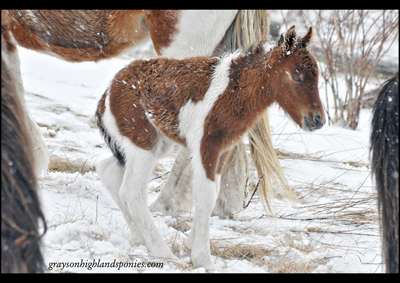 |
| Peregrine a few days old and the first time Amy saw him. Photo by Amy Flood. Used by permission. |
Today Amy talks about Peregrine. In her own words:
"Peregrine was the first colt born in 2011. His dam is Eowyn and his sire is Pippin. I first photographed him during a ferocious spring snowstorm. In 2009, Eowyn had a blue-eyed colt, but did not foal in 2010.
Thus far, Eowyn has been doing a fairly good job of keeping him away from hikers/visitors, for which I am grateful. Unfortunately a lot of people ignore the rules and feed the ponies - even horse people don't seem to realize how damaging it can be. As long as he remains shy around people he won't be consume anything that will make him sick! :) "
To read more about these ponies and their history you can read the the Mustang A Day Challenge News blog with additional links to the Grayson Highlands State Park http://mustangadaychallengenews.blogspot.com/
Thus far, Eowyn has been doing a fairly good job of keeping him away from hikers/visitors, for which I am grateful. Unfortunately a lot of people ignore the rules and feed the ponies - even horse people don't seem to realize how damaging it can be. As long as he remains shy around people he won't be consume anything that will make him sick! :) "
 |
| Peregrine is growing daily under the watchful eye of his mom Eowyn. Photo by Amy Flood. Used by permissioin |
To read more about these ponies and their history you can read the the Mustang A Day Challenge News blog with additional links to the Grayson Highlands State Park http://mustangadaychallengenews.blogspot.com/
and follow Amy's visits and photography on her blog http://graysonhighlandsponies.com/
For more information on the Grayson Highlands State Park Pony Auction The Wilburn Ridge Pony Association holds an auction at 2:00 PM on the Saturday following the 4th full week in September. The auction is part of the Grayson Highlands Fall Fest. All auctioned ponies have passed veterinary examination and testing, and the proceeds from their purchase goes toward sustaining the pony herd and local charities. For further information call: 276-579-7092 or go to
For more information on the Grayson Highlands State Park Pony Auction The Wilburn Ridge Pony Association holds an auction at 2:00 PM on the Saturday following the 4th full week in September. The auction is part of the Grayson Highlands Fall Fest. All auctioned ponies have passed veterinary examination and testing, and the proceeds from their purchase goes toward sustaining the pony herd and local charities. For further information call: 276-579-7092 or go to
Tuesday, April 26, 2011
"Going for a Spin" with Robert and Watson Challenge Painting #96
Robert and Watson "Going for a Spin"
Training for the Ft Collins Mustang Makeover
 |
| "Going For A Spin" Robert Carlson and Watson 8 by 10 inch watercolor by Linda L MarinArtist |
Today’s painting features Robert and Watson and is based on a wonderful photo by Amy Spivey of Lightning Bug Creek Photography of Robert literally taking Watson for his first spin. What starts out as a warm up exercise to help the horse soften to turn in both directions will eventually be able to work into a reining spin.
Taking a Mustang through the stages of training can be one adventure after another on a good day. But try keeping to your training schedule when you are threatened with a tornado, hail and more severe weather than you can imagine and the treat of raging brush fires all in the same week.
 |
| Madeleine and Tango crossing the bridge. |
The Last few weeks have been a steady introduction of new things and consistent repetition of what the mustangs Watson (Robert Carlson) And Tango ( Madeleine LeClerc) have learned. Besides introducing the horses to all sorts of obstacles one would find on the trail, both horses have been trailered to different locations to be ridden in doors, outdoors , with strange horses and through strange obstacles and at one location through a stock tank.
 |
| Robert and Watson loping in full saddle and cowboy halter. |
The most dramatic location training session was when Robert was riding Watson at a lope as a threatening storm loomed up. Through the high winds, a churning sky, and sirens, Robert rode Watson until Watson was calm and the two could end on a positive note. This was probably not what Robert had originally planned for this location training session, but it was definitely an opportunity to build more into to the partnership. Every opportunity must be taken to help the horse reach that level that requires a wild horse to trust the human and build confidence in all situations.
To read a more detailed account of all the training activities of the Madeline and Robert log into facebook and follow their daily updates on their Fort Collins Makeover blog page. http://www.facebook.com/pages/2011-CO-Mustang-Makeover-with-RM-Performance/119433394800806
To see more of Amy Spivey’s wonderful Photography check in to her facebook page for Lightning Creek Photography: http://www.facebook.com/pages/2011-CO-Mustang-Makeover-with-RM-Performance/119433394800806#!/LBCPhotography
Photographs provided by Lightning Bug Creek Photography. Used by permission.
Wednesday, April 13, 2011
"Can Wakan" of The Sand Wash Basin Challenge Painting #88
The First of the Sand Wash Basin 2011 babies has been spotted.
 |
| "Can Wakan" 5 by 7 inch watercolor by Artist LindaLMartin |
The newly named Can Wakan is the Filly in Corona's Band out of the pretty sorrel mare named Lona. She was spotted and photographed by John Wagner on Sand Wash Basin this week. He and his daughter, Megan, named her Can Wakan which is Lakota for Sun Daner.
 |
| Photo of Can Wakan by John Wagner Used By Permission |
You can see more of John Wagner and Nancy Roberts wonderful photography of Sand Wash Basin and the Surrounding country side on the Sand Wash Basin Horses Wild Horses Page on Facebook http://www.facebook.com/#!/pages/Sand-Wash-Basin-Wild-Horses/101181969939406
Friday, April 8, 2011
Ready to Adopt Mustang Babies~ Challenge Painting #85
 |
| Adoptable Palomino Weanling 5.5 by 5.75 inches Watercolor by LindaLMartinArtist |
Gorgeous! Palomino Colt available for adoption. Contact Tracey Westbury at Mustang U for more information on this special baby. tracey.mustangu@gmail.com.
 |
| Palamino colt ready for adoption/ Reference photo provided by Tracey Westbury. Used by permission. |
Tuesday, March 29, 2011
" First Touch" Fort Collins Mustang Makeover ~ Challenge Painting #77
 |
| "First Touch" 8 by 10 inch Watercolor by LindaLMartin Artist |
“First Touch”
Painting number 2 following the Fort Collins Mustang Makeover with Madeleine LeClerc and Robert Carlson.
The first step in gaining the trust of a mustang is being able to have them accept your touch. Everything else is on hold until you get to that point. Getting there is step by step almost a dance of acceptance. Entering the space, the small world step by step until your hand is gently on the horse’s shoulder and he doesn’t flinch, he doesn’t move away.. There is an intimacy there that the horse connects with the handler. With a mustang it cannot be forced it must come by degrees so that the horse is not only willing to receive but he wants it and comes willingly.
 |
| Madeleine LeClerc using the whip to make first touch. Its not to threaten or beat the horse, but just used as an extension of the hand. |
The first time I ever saw a horse worked with in this way I discovered that the whip as a tool was really an extension of the hand. The lunge whip, that whip with the long leather on the end, folded around the whip and touching the horse, making space between the handler and the mustang but touching. When touched first with the whip.. soon he will except the hand. The key is touch
To follow the ongoing details of Madeleine and Robert you can like their Mustang Makeover page at this link on Facebook: http://www.facebook.com/home.php#!/pages/2011-CO-Mustang-Makeover-with-RM-Performance/119433394800806
 |
| Robert Carlson Making first touch with his hand. Photo illustrations and reference by Lightning Bug Creek. Used by permission. |
Wednesday, March 23, 2011
Crow, Harem Mare of Sand Wash Basin HMA Challenge Painting #73
Crow of Sand Wash Basin.
 |
| Crow 8 by 10 Watercolor by LindaLMartinArtist |
Crow is also one of the Sand Wash Basin Mares that is currently being given the birth control drug PZP to try to control the population growth of the Sand Wash Basin herd. The idea is that if the study that begun in 2008 is successful then there will be zero population growth in the Sand Wash Basin Herd while still maintaining the genetic viability of the Herd. Ideally the mares given PZP should not produce a foal for up to three years. If the study proves successful then round ups of the wild horses will happen less and less and thus prevent disruption of the normal behavior of the wild horses of the Sand Wash Basin. The study, currently being conducted by the HSUS is due to be completed in 2012.

 |
| Correction: Crow with her 2010 foal is on the Right in this photo. The black horse on the far left if Crow's 2009 colt. |
Friday, March 18, 2011
Steens HMA Week: " Available and Adoptable Black Filly" from Stinkwater HMA Challenge Painting #70
 |
| Black Filly 9 by 6 Watercolor by LindaLMartinArtist |
This little filly from Stinkwater HMA in Oregon evokes all sorts of benevelont emotions, however she has yet to find an adoptive home. She seems to have three marks against her that probably should stir up the desire to rescue this baby from her implied circumstances rather than make her a less appealing adoption prospect. The first is the name of her HMA. Stinkwater doesnt exactly suggest the romantic herds that Pryor Mountains, Kieger, and Steens bring to mind. Of course that doesnt make her any less a daughter of great mustang stallions and a historic legacy of our Wild Horse heritage.
 |
| Filly #666 Photo by Tracey Westbury Used by permission |
Our Guest Blogger Tracey Westbury says this about the little mare:
"This adoptable filly has fallen under several different nicknames; Sixes, Night Mare, Witchy Woman...her tag number is the unfortunate 666.
It doesn’t help that she's all black and in her photo she has birds hanging off from her shoulder. And yet this is what also endears her to so many people who've seen her photo. She's obviously not happy about those birds there.
This filly is from Stinkingwater HMA. Horses here have a strong draft influence and range in size from 14.2-16 hands. There are many roans to be found, along with bays, sorrels and blacks. She's located currently at the wild horse corrals in Oregon.
Wednesday, March 16, 2011
Steens HMA Week "Jingles and Juniper" Challenge Painting #67
 |
| "Jingles and Juniper" 5 by 7 inche Watercolor by Linda L MartinArtist SOLD |
"The story of Juniper (colt) and Jingles (mare) has captured a lot of hearts. These photos were taken in late Oct, 2010. Wildlife Photographer, Barbara Wheeler spotted Jingles and her newborn in mid-Sept. When we reported that we'd spotted a mare who was extremely down in weight, we had a lot of people telling us that was normal for a mare who'd just foaled. But upon seeing the photos, people were surprised at just how down in weight she was. Coming into winter, when the snow could be several feet deep, we questioned whether she and her colt would survive.
 |
| When this photo was taken at the end of Autumn you can see the dip in the mare, Jingle's, backbone,that is caused by loss of condition. In an older mare such as Jingles, this is probably because she is feeding all the nutrients she consumes to her foal instead of building up her own stores for winter. Had the winter been worse the mare would have probably perished and her foal would have been nurtured by an aunt with in the herd. |
The two have been spotted a couple more times this winter. Juniper is now 5 months and a very healthy colt. Jingles, who at the time of these photos appeared to be a lead mare, now staggers along a good hundred to two hundred feet behind her band. Her stallion appears annoyed with her, willing to leave her behind, not giving her a second glance. When at the watering hole or a mineral deposit, Jingles stays a good distance away, waiting for everyone else to finish before cautiously moving in.
The winter has been kind to her...no snow on the mountain! This has enabled her to continue to get enough nutrition to feed her colt. If she were to die tomorrow, Juniper would be strong enough to survive. But there is no doubt that Jingles won't be with us much longer. "
Editor's Note: This story was written in February and as of Tuesday March16 both Juniper and Jingles have been photographed. Juniper is in fine condition and has lost all of her baby fluff and has turned into a beautiful rich chocolate silver that just glistens in the sunshine. Jingles did indeed make it through the winter. The resilience of Mustang mares is remarkable. She is now beginning to put on weight. According to one horse watcher they are hopeful that after 15 years of having foals she will be barren this year and in coming years, which will allow her a chance to live out her life healthy. If you would like to follow more of the Steens horses please log into Facebook and go to the "Sister's of the Steens" page. There are photos, discussions, and a number of people who can tell you how to visit these horses safely.
A portion of the proceeds of the sale of this painting will benefit Mustang U.
Tuesday, March 1, 2011
Adoption: "Tavaci" From Nevada Wild Horse Range- Challenge Painting #57
Tavaci was adopted by photographer Amy Spivey and her husband, Christopher, in September 2010.
Tavaci, was rounded up in July of 2008 from the Nevada Wild Horse Range. He was born in 2007 according to his Bureau of Land Management Tatoo. The sorrel gelding with the long silver flaxen mane and tail was trained by Texas trainer Robert Carlson.
According to Amy, Robert, along with Fiancé Madi LeClerc, have both worked with Tavaci.
Readers may remember that Artista and Riley in previous Adoption posts where both horses that came out of Robert and Madi’s Training Facility. In addition to training TIP and adopted mustangs, as well as other horses, both Robert and Madi compete in the Mustang Makeovers held by the Mustang Heritage foundation .org.
Amy’s Lightenning Bug Creek Photography documents the training activities of Robert and Madi through out the year as they prepare for competition in the Mustang Makeovers.
Amy says that Tavaci is to be her husband’s trail horse.
 |
| "Tavaci" 5 by 7 Watercolor by Linda L Martin Artist |
Tavaci was adopted by photographer Amy Spivey and her husband, Christopher, in September 2010.
Tavaci, was rounded up in July of 2008 from the Nevada Wild Horse Range. He was born in 2007 according to his Bureau of Land Management Tatoo. The sorrel gelding with the long silver flaxen mane and tail was trained by Texas trainer Robert Carlson.
According to Amy, Robert, along with Fiancé Madi LeClerc, have both worked with Tavaci.
Readers may remember that Artista and Riley in previous Adoption posts where both horses that came out of Robert and Madi’s Training Facility. In addition to training TIP and adopted mustangs, as well as other horses, both Robert and Madi compete in the Mustang Makeovers held by the Mustang Heritage foundation .org.
 |
| "Tavaci" Reference Photography by Amy Spivey/Lightening Bug Creek Photography Used by permission |
Amy says that Tavaci is to be her husband’s trail horse.
Tuesday, February 22, 2011
Adoption: " Col. Mustard" Mustang A Day Challenge #52
Col.Mustard was the favorite of his owner Kat Moser. She saw this beautiful silver palomino in an auction and didn't know he was a mustang until she brought him home and saw the BLM freeze brand under his mane. She was very new to horses at the time and he was one of her first riding horses. " I only had him for a couple of years" she said in her email to me. " I wish I had taken more photos and especially one of his brand so I would know where he came from."
Alder Hill Farm in Missouri: http://www.alderhillfarm.com
Mustang U in Washington State: http://mustangu.blogspot.com/
Should you have a horse you have obtained through a public auction horse sale or private sale, and suspect that it might be a mustang, because it has a freeze brand on its neck, you can either check with your local brand inspector or contact the nearest BLM office to find more information on your new horse.
 |
| "Col. Mustard" 5 by 7 watercolor by LindaLMartin Artist |
Col Mustard was 24 when she sold him to his new owners. "no one could believe how old he was until they looked at his teeth" She guesses that he must be about 29 now. This wonderful mustang made a good trail and companion horse. But Kat was very clear that Col. Mustard was the strongest horse in the "corral".
Many times people wonder how an obviously well trained and acclimated horse like Col. Mustard gets in to the horse auction sale pipeline. Generally speaking there are very strict procedures for adoption, including specifications as to the type of housing you must have for your adopted horse, what sort of food and vetting, as well as training you are responsible for. And there are spot checks as to making sure that you are keeping to the agreement and quality of care required. Then when you have met the requirements you can decide to return the horse or the horse is titled over to you by the BLM. This entire process takes about a year. Then you own the horse outright and basically are allowed to do any legal thing with the horse, including keep or sell the horse, once you have title.
 |
| Col.Mustard refrence photographry by Kat Moser. Used by permission. |
There is a data base at the BLM of every horse that is rounded up and branded. Those brands tell how old the horse is, where its original HMA was, and what the special information there is on there horse including the first person to hold the title of the horse and/or if the horse was returned etc. However once the horse is titled to a private owner the paper trail ends. If you would like to look into adoption there are two places begin looking.
At the BLM sight: http://www.blm.gov/ca/st/en/prog/wild_horse_and_burro/adoptions.html
Another place you can look to adopt a mustang are private rescues who sometimes rescue or have a surrendered Mustang. They will handle them and train them, then guide you through the process to learn to connect or join up with your new mustang. Search on line for a Horse rescue local to you or you can start with one of these two registered non-profit organizations.
Mustang U in Washington State: http://mustangu.blogspot.com/
Should you have a horse you have obtained through a public auction horse sale or private sale, and suspect that it might be a mustang, because it has a freeze brand on its neck, you can either check with your local brand inspector or contact the nearest BLM office to find more information on your new horse.
Thursday, February 17, 2011
Adoption: "High Sierra" from Cyclone Rim , Wyoming Mustang A Day Challenge #50
 |
| "Sierra" 8by10 Watercolor by Linda L Martin |
 |
| "Sierra" Photo and Reference photography by Julie Gaspar Used by Permission |
Monday, February 14, 2011
Romance on the Range " Picasso and Monet" SWB HMA Mustang A Day Challenge #47
 |
| Just a Little Kiss Picasso and Monet Sand Wash Basin HMA 8 by 10 Watercolor by Linda L Martin |
Today being Valentines Day I decided to do a special Watercolor of Monet and Picasso from a delightful photo by another wonderful Colorado Wildlife Photographer, John Wagner. He spent quite a bit of time in the Summer and Autumn of 2010 capturing images of the Sand Wash Basin herd and the families of Wild Mustangs there. In a series of shots with Picasso and Monet they always seemed to be close to each other and Picasso doted on the buckskin mare.
John just recently published his first book of photography where he captured the family life of eagles even through the hatching and raising of their young. He tells me that now he is working on his second book. This one a pictorial essay of the Wild Horses of Sand Wash Basin HMA. I hope you enjoy this collection of Sand Wash Basin couples in my Romance on the Range Series.
 |
| Picasso and Monet Reference Photography by John Wagner Used by permission |
Friday, January 28, 2011
Mustang A Day Challenge #35"Carmel" January Special to Benifit Alder Hill Farm Mustangs
Carmel: The Rest of the Story.
Often times in owning horses we never get to know their entire story and how they came to be as they are because often horses are traded like cars sometimes having up to 10 owners in their lifetime if they reach old age. After I posted the story of Carmel yesterday I heard from one of Alder Hill Farm Rescue's Founders, Leslie Maxwell.
Leslie actually started in equine rescue in 2005 when she and her husband Craig rescued 60 purebred appaloosa foals from certain death. Although both Leslie and Craig are full time professionals with careers, their passion and lifestyle revolve around horses.Taking on these 60 babies, having them trained and then adopted to forever homes opened up a way of life that not only has been a vast learning experience but it has made Leslie uniquely qualified in the care of throw-away horses. Specifically horses who are the bi product of the estrogen replacement therapy called Premarin also known as PMU.
This is in Leslie's own words regarding how Carmel came to be at Alder Hill:
"
" Thank you Linda for the lovely write up about this extra special boy!
Carmel was rescued from an auction in ND where he was being sold for drug testing along with 9 other mustang pinto foals. The foals were from a PMU ranch where the babies are often jerked away from their mothers at very young ages as the foals are concerned a 'waste by-product" of the industry. This would also fit in with the orphan foal syndrome symptoms that Carmel exhibits.
The foals that survive were often sold for slaughter, most commonly they were flown live from Canada to Japan where the young horse meat is a delicacy and is served thin-sliced, sushi style. We were able to take 5 of the foals, while Serenity Acres was able to save the remaining 5 foals. I am thankful there are not any PMU ranches left in the US and less than 20 in Canada at this time."
For those who don't understand the intricacies of Premarin or PMU manufacturing, basically what is done is to keep a mare pregnant and standing in a stall where she has very little exercise and a special bag is attached to her so that the estrogen laden urine can be collected for synthesizing into hormone replacement for menopausal women. These horses are kept in narrow stalls and not even aloud to lay down. Today there is very little need for PMU ranches as Premarin is pretty much outdated therapy and much better medicines are used with out the side effects and the risk of certain cancers that come from using Premarin.
If the conditions of the Premarin mares, as well as, the total lack of need for the medicine, and the throw away foals, don't make you outraged by this whole process then think of this: Some of the mares in these facilities are mares that were taken off the range in the USA and purchased for this purpose then shipped to Canada. The question is how did this happen? Why is an animal deemed by law a National Treasure to be protected and preserved in the United States of America being sold to the highest bidder to live an unnatural life of confinement, to have one foal after the other and never be able to nurture those foals and to have those babies ripped from them right after birth never to see them again. There is no knowledge of Carmel's Sire. But his mom and the mother's of all the PMU mustangs rescued by Alder Hill Farm were mustangs.
It is no wonder that Carmel had lasting side effects from the treatment he received from birth until he reached Alder Hill Farm. There of course is no way of knowing exactly how he was treated during the time before Alder Hill received him and his 4 companions. But for him to show the symptoms he does, with the inability to socialize, his treatment was most probably extreme.
The Oil painting I have done of Carmel tonight will be offered for sale in three weeks as it must have time to dry. A part of the proceeds from the sale of this painting will go to fund the sanctuary mustangs at Alder Hill Farm.
 |
| "Carmel Remembering" Sanctuary Mustang Alder HIll Farm 8 by 10 oil painting on Canvas board by Linda L Martin |
Leslie actually started in equine rescue in 2005 when she and her husband Craig rescued 60 purebred appaloosa foals from certain death. Although both Leslie and Craig are full time professionals with careers, their passion and lifestyle revolve around horses.Taking on these 60 babies, having them trained and then adopted to forever homes opened up a way of life that not only has been a vast learning experience but it has made Leslie uniquely qualified in the care of throw-away horses. Specifically horses who are the bi product of the estrogen replacement therapy called Premarin also known as PMU.
This is in Leslie's own words regarding how Carmel came to be at Alder Hill:
"
" Thank you Linda for the lovely write up about this extra special boy!
Carmel was rescued from an auction in ND where he was being sold for drug testing along with 9 other mustang pinto foals. The foals were from a PMU ranch where the babies are often jerked away from their mothers at very young ages as the foals are concerned a 'waste by-product" of the industry. This would also fit in with the orphan foal syndrome symptoms that Carmel exhibits.
The foals that survive were often sold for slaughter, most commonly they were flown live from Canada to Japan where the young horse meat is a delicacy and is served thin-sliced, sushi style. We were able to take 5 of the foals, while Serenity Acres was able to save the remaining 5 foals. I am thankful there are not any PMU ranches left in the US and less than 20 in Canada at this time."
For those who don't understand the intricacies of Premarin or PMU manufacturing, basically what is done is to keep a mare pregnant and standing in a stall where she has very little exercise and a special bag is attached to her so that the estrogen laden urine can be collected for synthesizing into hormone replacement for menopausal women. These horses are kept in narrow stalls and not even aloud to lay down. Today there is very little need for PMU ranches as Premarin is pretty much outdated therapy and much better medicines are used with out the side effects and the risk of certain cancers that come from using Premarin.
 |
| "Carmel" Courtesy of Alder Hill Farm Rescue Photo used by permission Reference photography for the Challenge painting used by permission of Scott Litherland via Alder Hill Farm |
It is no wonder that Carmel had lasting side effects from the treatment he received from birth until he reached Alder Hill Farm. There of course is no way of knowing exactly how he was treated during the time before Alder Hill received him and his 4 companions. But for him to show the symptoms he does, with the inability to socialize, his treatment was most probably extreme.
The Oil painting I have done of Carmel tonight will be offered for sale in three weeks as it must have time to dry. A part of the proceeds from the sale of this painting will go to fund the sanctuary mustangs at Alder Hill Farm.
Thursday, January 27, 2011
Mustang A Day Challenge #34 "Carmel" January Special to Benifit Alder Hill Farm Mustangs
The challenge had challenges today, so I ended up doing a wonderful graphite drawing of today's Subject from Alder Hill. Occasionally there really are special needs horses and this particular mustang is one of those. Mustangs in general, because of the natural selection so predominate to their survival in the wild, must have a keen sense of the interaction with the herd as well as the ability to stay focused and problem solve. These qualities make Mustangs unique among all horses and once a person connects with that horse the relationship between horse and person is phenomenal in its intricacies and communication.
 |
| "Carmel" Graphite on Watercolor Paper 5 by 7 inches by Linda L Martin |
Because of this traditional forced based domination training rarely works and usually only serves to abuse the animal and break its spirit, what expert horsemen have found is that patients, gentleness and natural horsemanship is the only sure fire way to "join up" with a wild horse. Building a relationship that teaches leadership and channels all the skills a wild horse has to make it into a useful and well adjusted and adapted Mustang in a domestic environment is the best way. Trust and focus are the only way this can be accomplished.
However, Carmel the beautiful sorrel pinto, has a disconnect when it comes to focus that makes him undependable. I wonder how this would play out in a wild sense to have a horse with this problem, almost like an equine autism or asbergers. I say asbergers because he does seem to understand and learn. From what I understand according to Alder Hill's Head Horseman, Scott Litherland, Carmel just doesn't seem to be able to have that ability to connect with the humans. He seems totally unable through chemical make up to focus on how his actions affect anyone other than himself or how they put him or others in danger, for that matter.
I have picked up little bits of information here and there on aspergers and autism through reading and knowing children and at least one adult with the condition. Believe me, its something that is either caused through environment or something intrinsically born into the person. Sensory perception such as feel, taste, hearing sight is so heightened that they avoid everything that causes them pain from the experience. The moms I have known, with children with more extreme forms of the condition, are frustrated and at a loss because they want to hug and love their children, they want to bond with them, cuddle them. A child with the condition can't or is so far removed from the concept of human contact and connection that they live almost in an invisible bubble.
 |
| "Close up of Carmel" Photo courtesy Scott Litherland via Alder Hill Farm Rescue |
Which brings me to another important fact regarding horses with autism. Because not enough work has been funded for observing and documenting horses in the wild we don't know much about how they survive and how they deal with these issues as they arise. We don't know what happens to cause a foal to become a failure to thrive yearling like Sparrow in one of my previous posts.
The bad thing about it, as I was doing research on equine autism for this challenge drawing, I came across some horrendous stereotypes and ignorance regarding horses in general and conditions like autism. Most horsemen attribute behavior like Carmel's to Orphan Foal syndrome.
There is no doubt in my mind that there is such a thing in as Orphan Foal syndrome but I don't think that it is the same thing as autism. Yet autistic behavior is often attributed to Orphan Foal syndrome among domestic horses that have no ability to connect with humans or have no social skills in a herd situation. Orphan Foal syndrome is usually caused by isolating a newborn horse and only interacting to feed it. Its a horrid form of abuse that never lets the animal develop social skills or and usually causes the animal physically difficulties because it is usually neglected in every way. There is hope for horses with Orphan Foal syndrome, however, it takes love and patience and a lot of kindness. The person handling the animal with Orphan Foal syndrome is basically charged with the task of showing the animal how to be a horse. Something it should have learned from a baby from its mother and from interaction with other horses. Then it can be conditioned and repurposed to be useful. In the case of Carmel he was an adult horse that was still with his mother.
I found this difinition of asperger's syndrome when researching on the web from the site http://www.aspergers.com/ :
 |
| Detail of Carmel Drawing |
As you can see Autism is a completely different from Orpan Foal syndrome inspite of the simularities in results. Autism causes the foal to isolate its self and focus on its own repetitive behavior. In Orphan Foal syndrome the foal is forced into unatural isolation by a human, causeing it to be unable to socialize, learn and develop. A horse with Autism might be given all the love and patience but will always have limited ability to function and be useful in the way an average rightly wired horse does. A horse like this can successfully live out his life in sanctuary and interact at his own level with out suffering abuse. This is the plan for Carmel through Alder Hill Farm.
.
A portion of the proceeds from the sale of this drawing will benifit Alder Hill Farm's Sanctuary Mustangs. Please go to the Mustang A Day Challenge Store on Etsy to see more Original Art Available for Sale. http://etsy.com/shop/MustangADayChallenge
Subscribe to:
Posts (Atom)


