Tuesday, March 8, 2011

Silvers and Golds of the Sand Wash Basin "Irma and Isabella "Challenge Painting #62


Isabella and Irma are the featured Golden Horses of the Sand Wash Basin tonight. 

"Irma and Isabella"
6" by 9" Watercolor
By Linda L Martin Artist

They are from Centauro’s band. This mother and daughter are palominos meaning they are golden, or blond, in color with white manes and tails.

The dapple gray stallion, Centauro, has mares that throw their own color. Whatever the dam’s ( or mare’s) color, that is the color the foals seem to be. It’s only been since the round up in 2008 that Centauro has had these mares. So far none of his offspring have shown the trait to gray. His mares were part of the on-going PZP birth control study at Sand Wash Basin HMA so they had no live foals among this band in 2010. When this photo was taken by Nancy Roberts  there were 4 mares and 4 yearlings. Notice how the yearlings all look like their mothers.


Here is what our guest blogger, Debra More McGuire  has to say:

“The gray stallion must not be homozygous gray or his foals would gray. The fact that his foals tend to be the mares’ color would mean that his base color would not be a dominant one. He would most likely be a red base.
Homozygous would be dominant. That the horse could only pass that gene on for color (or trait). As in a HZ tobiano would always have a spotted foal regardless of the other parent. It is supposed to be 99.9 percent accurate. So a Homozygous gray horse would always produce a gray offspring regardless of  the color of the other parent.“

Would you like to  know more about horse color genetics? Deb recommends this web site to widen your knowledge: http://www.equine-color.info/gallery

Monday, March 7, 2011

Silvers and Golds of the Sand Wash Basin "Flirt" Challenge Painting #61


This week as we talk about the Gold Horses of the Sand Wash Basin I’ve asked  Horse Breeder  Debra Moore McGuire to be our guest blogger.
Debra began her research into genetics and colors when she purchased her first foundation Quarter Horse in 1981 "In researching his coloring I met and learned much about colors and breeding from Virgean Miller, one of the pioneers of the Buckskin breed."

The first horse we will go over this week is one that has been causing quite a stir on the Sand Wash Basin HMA. We call her a sooty palomino. But She and her mother are of such strange color combinations. Flirt is her name. Flirt is a deep gold dapple palomino with burnishes of dark brown or black giving her a sooty color. Flirt’s mom appears to be a grulla, however with burnish marks on her shoulders and hips of a deep gold in the midst of her darker coat.

  I asked Deb about the two of them.
“The little mare with your Flirt filly is a gray not grulla. The gold "burnishes" are part of her palomino coat that is left over. She was probably the same color as the filly as a foal.


Flirt and her Mother, Ellie in the Summer of 2010
Here Flirt is a yearling. Notice how Ellie has
 burnished gold under coat  and a dorsal stripe almost
like a grulla.  Flirt does have a very faint dorsal stripe,
 does have sooty burnish marks. Interestingly Corona the
Dunalino band stallion has burnish marks too on his 
face and legs but not to the extent of these two mares.

She looks like a younger mare and that would be why she still has so much color in her coat. She shows no dun factor (even though she might have counter shading, which would give her a faint dorsal look alike).
Her mane and tail definitely show the graying in that they are two-tone, black/white/yellow hairs. She is the type of gray that will go lighter very slowly over the years. And it may not even be real obvious until you look at photos with a 3-4 yr span between them. The points on this kind of gray go light the slowest. So her and the filly will have darker legs for a long time.

From seeing all the photos from SWB horses there does seem to be a lot of gray in those bands. But with all the dun/red dun/palomino horses out there you will get some very odd looking colors in the graying process.

The silver dappling and graying gene are actually 2 different ones. Here is the description they give for grey that may make it easier to understand.


Reference photo for this painting by
John Wagner. Used by permission.
"Contrary to popular belief, grey is not so much a color as it is a pattern (or more accurately still, a color modifier). Grey is a dominant gene that causes the horse's natural coat color, whether it be bay, black, dun, or palomino roan, to slowly "depigment" as the horse ages, much like human hair, regardless of the color, "greys out" with age" .  Because it is a modifier rather than an actually color is why that you can get so many shades and colorations in grey horses.

You can also have a "slipped" tobiano (which would be like what you were talking about in the cats), where you have a tobiano born from homozygous parents but it actually shows no white. If you did DNA on it you would find it is still a tobiano. Homozygous means it’s a dominant gene.


Please stop by the Sand Wash Basin Wild Horses page on Facebook and Say Hi. Right now Nancy Roberts is in the process of Forming a Club to continue the public documentation of this herd. You can access the page by going to : http://www.facebook.com/?sk=lf&closeTheater=1#!/pages/Sand-Wash-Basin-Wild-Horses/101181969939406

Saturday, March 5, 2011

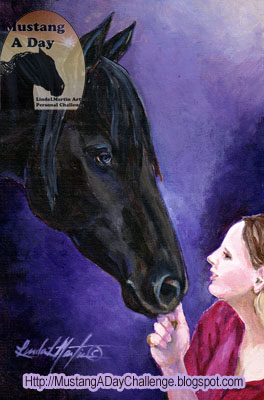
Adoption: "Maggie Moo"Twin Peaks HMA Challenge Painting #60


"Joined"
Maggie Moo and Michele
When Michele Cole emailed me the other night to commission a painting of her 4 year old Mustang. I asked her what pose she would like. She gave me free rein  and then said” Just a good picture of her that shows her strong loving and loyal personality.”
She also did some thing else that really helps me. She sent me lots of photos to draw from. Photos that showed the wonderful relationship that Michele and her Maggie Moo have.  Then  Michele gave me the only one real instruction. She likes Purples! My creative juices started flowing…and my imagination took over.
This is an awesome opportunity to paint that intimacy that mustangs are capable of when they "join up" and totally trust their person. For the uninitiated  the term "join up" means that a strong connection of trust is established between a horse and its handler. Its often based on respect of space and understanding the nature of horse behavior. When a horse is ready to come to the person on their own the bonding begins.

There has been a lot of debate as to whether Mustangs are more happy in the wild or more happy near a good food source and warm barn. I say mustangs are not stupid.  If given the choice in a non abusive situation they are going to choose the good food source and warm barn. It’s a plus if they have the freedom to come and go as they choose, except for  the occasional ride and quality time with their human
However you have to get them past their fear of a strange place,  past the adjustment time of their first confinement  and  step beyond archaic traditional force based training methods to get them there into patient and gentle degrees of trust. 
Generally speaking for a new Mustang Owner who has never trained a horse its always good to read as much as possible about how to successfully gentle a wild horse, go to clinics when ever possible,  and it is especially important to find a trainer that will work with you and your horse, that specializes in and knows the needs of the wild horses.
The majority of successful adoptions of wild horsse are because the new adoptive owner  received good instruction  and over sight on how to gentle their horse. The majority of  failed adoptions are because the new adoptive owner was in over their head and never sought out the help needed to learn  the finer points of working with a Mustang.
Michele received Maggie Moo for the adopton process when Maggie was 6 months old. Maggie Moo had been rounded up from the Twin Peaks round up in 2007. It is with great pleasure that I feature the two of them as the final painting for the miniseries “Happy Adoptions Part 1.  And Mustang A Day Challenge Painting #60

Part 2 will be in a few weeks. Please recommend horses for that one. We are looking for a total of 10 Happy Adopted Mustangs. We currently have 5.   There will also be several more opportunities to have your horse featured as well.  So dont hesitate to email me at contact@llmartin.com  Comissions help fund the project and also help a number of Mustang related Charities.

Thursday, March 3, 2011

Adoption: "Chica" from Onaqui HMA, Utah- Challenge Painting #59

Chica is one of two mustangs that Bobby and Karen Strawbridge have adopted from the Onaqui HMA in Utah. At the time of the Adoption the plan was to remove the entire herd. The complete removal of the Onaqui herd was a point that Karen didn't know at the time they adopted. " Had I known I would have gotten more of the herd."

"Chica"
5 by 7 inch Watercolor
by LindaLMartin

The official reason for the complete removal of the herd was lack of sustaining water source and grazing forage due in part to drought.  Even after the  entire herd was thought to have been removed Karen told me  it wasn't long until  she discovered that to everyone's surprise there were still 75 wild horses roaming around on that particular range.

According to the censis in 2008 there were approximately 177 wild horses still in the Onaqui HMA. And From photos by horse watchers at the time, the BLM put out huge wooden watering troughs so the horses remaining would have a water source.

The tenacity and survivability of the Mustang never ceases to impress as they seem to thrive in the wildest places one the least amount of forage. Still many people, my self included, question the wisdom of leaving to chance the water sources needed for the horses to survive on the range. Like some eco-gerrymandering, sometimes the Federally controlled range lands are cut off from water supplies in some desert areas. The lands are often interspersed with private and state lands. Wisdom would say establish a water source on the Federally managed lands and that way in drought the horses wouldn't be invading lands where they might be seen as more than just competition for resources, but where they are more than likely seen as pests and worthy of destruction.

Alas conventional wisdom does not always apply. In this economic time it would seem a far more economical avenue to put in some sort of water source where its needed rather than to entirely remove a herd which costs thousands per horse rather than $25 or $30 a head to establish a fresh water location available to all the wildlife on the range. And pennies per horse to maintain.

When doing a bit of research on the Onaqui Mustangs I came across some very stark photography taken in 2008 and 2009 of the range. Very similar to the Sand Wash Basin in Colorado in plant life, how ever there was far less off it and the vegetation was much lower to the ground. Were that area in normal rain and water levels, one wonders how the range there would look. If you want to know more about the Onaqui Mustangs just search Onaqui Wild Horses and lots of information will appear on google and yahoo.


In their new home with lots of rain, lots of shade from the many hardwood trees, plenty of lush green grass, Chica and her herd mates had gone from complete desert to the green green forests and pastures of the East, specifically in Tennessee. The Mustangs  have more than made the adjustment, they are part of  daily life for the Strawbridges. " Chica is my love" Karen insisted in her last e-mail. In fact Karen and her family have made it their mission to act in an attitude of gentleness and love toward all of their animals. The more I go on my quest of paint a mustang a day there is one over-riding thing I have discovered: the great ability of mustangs to gently show affection once there is a bond of trust between their owners and themselves. More on getting to that point later in the series.

Wednesday, March 2, 2011

Adoption: "Domino" Alder Hill Farm Rescue- Challenge Painting #58


"Domino and Leslie"
6 by 9 inch Watercolor
By Linda L Martin Artist

 Domino is Happily Adopted by  Leslie's Maxwell co-founder of Alder Hill Farm Rescue. Domino is Leslie's personal  trail horse. According to Leslie, Domino was not captured until he was 9. Was was gelded at 12,  He is 14.   Domino was surrendered to Scott Litherland when his adoptive family could not longer keep him.  Leslie also said Domino is wonderful on the trails and has stamina and heart. Domino's training is on going and sometimes when running with the herd at Alder Hill, his Mustang band stallion tendencies tend to come out.  He tends to gather the Alder Hill mares when he is running out at pasture.

Domino and Leslie
Reference Photo provided by
Alder Hill Farm Rescue
Used by permission
One of the unique ways of helping him regain his focus is to remove him from the bigger horses and put him in with the Alder Hill Minis Napoleon and Prince and their friend the mini donkey. In this small enclosure Napoleon is the herd boss.

A portion of the proceeds from the sale of this painting will go toward the up keep of rescued Mustangs at Alder Hill Farm.
If you would like to read more about the Rescue Efforts of  Alder Hill Farm go to: www.alderhillfarm.com
or search Alder Hill Farm on Facebook. Alder Hill Farm will be Participating in Horse Fest  Beginning March 11th in Spring Field Missouri.  To see the schedule and details go to http://www.horsefest.net/schedule.html  Alder Hill's Mini Horses will be there to meet and greet and get a treat.  Please stop in and Say Hi!

Tuesday, March 1, 2011

Adoption: "Tavaci" From Nevada Wild Horse Range- Challenge Painting #57


"Tavaci"
5 by 7 Watercolor
by  Linda L Martin Artist

     Tavaci was adopted by photographer Amy Spivey and her husband, Christopher,  in September 2010.
Tavaci, was rounded up in July of 2008 from the Nevada Wild Horse Range. He was born in 2007 according to his Bureau of Land Management Tatoo.  The sorrel gelding with the long silver flaxen mane and tail was trained by Texas trainer Robert Carlson. 
According to Amy, Robert, along with FiancĂ© Madi LeClerc, have both worked with Tavaci.  
Readers may remember that Artista and Riley in previous Adoption posts where both horses that came out of Robert and Madi’s  Training Facility. In addition to training TIP and adopted mustangs, as well as other horses, both Robert and Madi compete in the Mustang Makeovers held by the Mustang Heritage foundation .org.
"Tavaci"
Reference Photography by
Amy Spivey/Lightening Bug Creek Photography
Used by permission
Amy’s Lightenning Bug Creek Photography documents the training activities of Robert and Madi through out the year as they prepare for competition in the Mustang Makeovers.
Amy says that Tavaci is to be her husband’s trail horse.

Monday, February 28, 2011

Adoption: "Dusty" Scott Litherland of Alder Hill Farm Rescue Challenge Painting #56


"Dusty"
5 by 7 watercolor
by Linda L Martin

Dusty is Scott's new "Stang". I dont have the full scoop on him yet. But between this fellow and Scott it was love at first sight. According to Scott , Dusty is a very willing worker and since his surrender he has already been trail riding. Plus Scott has used him in horse herd management as a working stock horse. Pretty impressive for such as short time at Alder Hill Farm. I will up date this as I recieve more info so stay tunned. Things are very busy at Alder Hill right now as they are getting ready for their booth at Horse Fest. On March 11th.
A protion of the proceeds from this painting will benefit the Mustangs at Alder Hill Farm.